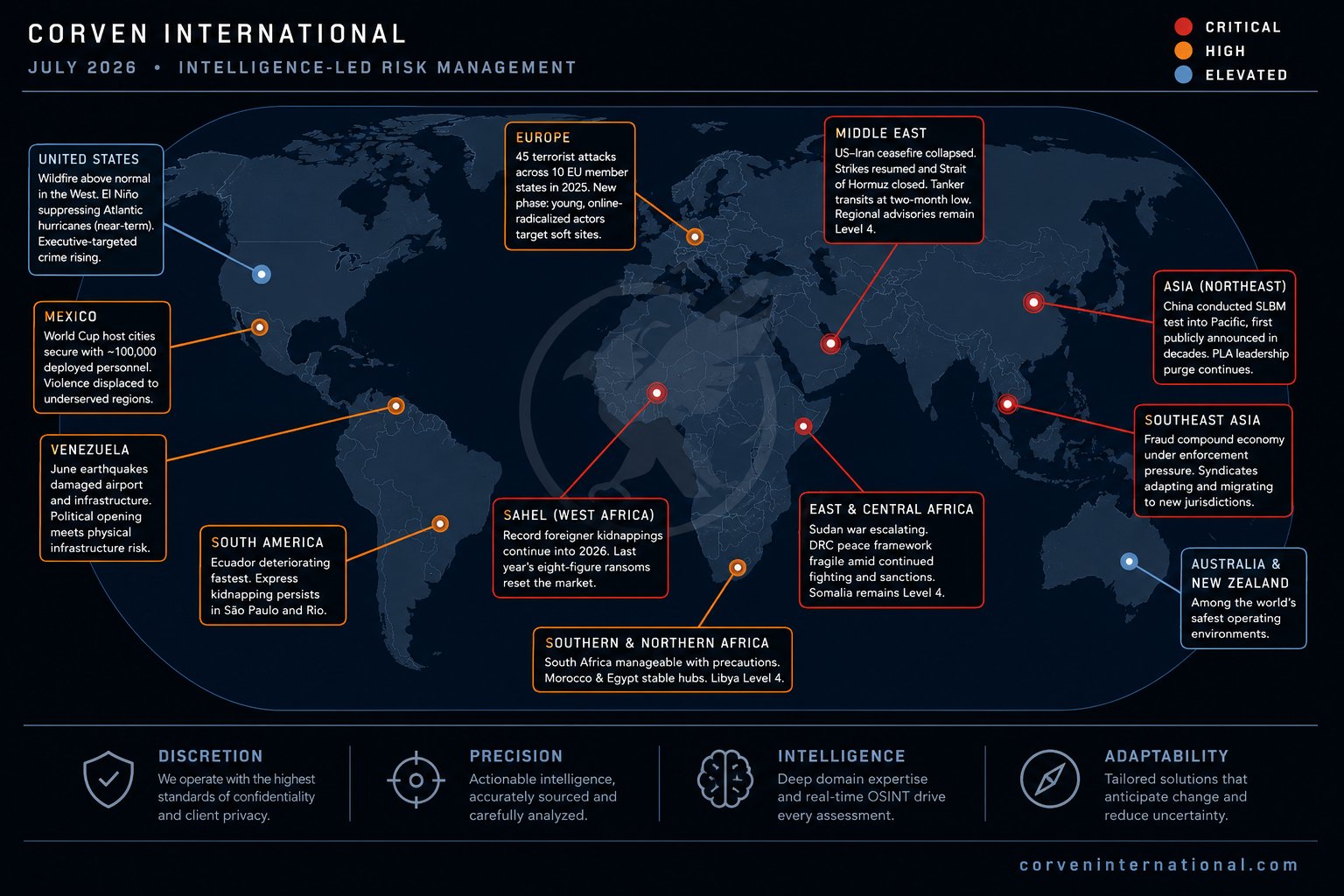
Global Risk Assessment
August 31, 2026 · Comprehensive Edition
August was the month the war stopped moving, and the pressure changed form.
The Gulf went almost three weeks without a US strike while Iran and Oman
drafted an arrangement to govern the Strait of Hormuz, and Washington
answered with the widest economic action of the conflict. Then, on the final
Sunday of the month, US forces struck rocket launchers near Larak Island that
were preparing to put sea mines back in the water.
The same shape held elsewhere. An explosive drone reached the apron of a
NATO airlift hub in Germany. A United Nations panel put a figure on how one
ransom payment financed a year of insurgency in the Sahel. A synthetic voice
reached four of the largest funds on Wall Street in a single morning. What follows
is our current assessment across all inhabited continents, backed by live OSINT
and government advisory data, with specific implications for protected travel,
duty-of-care programs, and family office risk.
PREPARED FOR
Principals, Family Offices & Institutional Clients
DATE
August 31st 2026
CLASSIFICATION
Public
COVERAGE
All Inhabited Continents
DISCRETION | PRECISION | INTELLIGENCE | ADAPTABILITY
I · MIDDLE EAST
The War Moves to the Ledger
Three weeks of near-quiet, an emerging Iran and Oman arrangement, the widest sanctions action of the
conflict, and a strike on the last Sunday of the month
The tempo of the war fell sharply in early August. Attacks on shipping and retaliatory US strikes,
which by mid-July had reached their highest volume since April, abated as Iran and Oman
advanced their own negotiation over the strait. On 5 August, Tehran said a joint statement setting
out a safe traffic route for commercial shipping was in final review and drafting. Muscat called the
talks positive and constructive on 8 August while warning, on the same day an ADNOC tanker was
struck by a missile in transit, that continued targeting of vessels put the negotiation at risk.
The arrangement under discussion would formalize rather than dissolve Iranian control. The
Persian Gulf Strait Authority, created on 5 May to authorize and regulate transit, stated on 23
August that vessels violating Iranian protocols face fines, detention or confiscation. Tehran's
negotiators have been consistent that management of the waterway will not return to its pre-war
condition. Traffic reflects it: transits are running at roughly a fifth of the pre-war average, and Iran
has begun granting selective passage, including to Iraqi tankers.
Washington's answer was economic. On 18 August the United Arab Emirates suspended all trade
and financial dealings with Tehran after two ballistic missiles it attributed to Iran fell in and near its
waters, an accusation Iran denied. Before the war, the UAE supplied more than thirty percent of
Iran's imports. The following day the President announced the most crushing economic operation
ever taken against a country, and on 24 August the Treasury Secretary launched it as Operation
Economic Outcast, blacklisting more than sixty Iran-linked targets, widening secondary sanctions,
and giving named countries defined timelines to end identified activity. It extends the Operation
Economic Fury campaign begun in April. Tehran has promised financial retaliation. The Chinese
leadership's scheduled Washington visit in late September is the obvious constraint on how far the
secondary measures actually reach.
On 30 August, US Central Command struck Islamic Revolutionary Guard Corps rocket launchers
near Larak Island that were preparing to fire rockets carrying sea mines into the strait. It was the
first US military action against Iran in a month. The IRGC acknowledged fighters and civilians killed
and wounded and promised punishment of the aggressor.
AVIATION & MARITIME
The European Union Aviation Safety Agency has maintained conflict-zone guidance for the
Persian Gulf and Gulf of Oman through 31 August, advising operators not to fly at any level in the
airspace of Bahrain, Kuwait, Qatar and the United Arab Emirates, or over the Gulf of Oman inside
the Muscat flight information region west of longitude 58 degrees east. Kuwait remains closed to
overflight, which removes the direct central routing and compresses Europe-to-Asia traffic onto a
southern corridor through Egypt, Saudi Arabia and Oman or a northern one through the Caucasus
and Afghanistan. Three airports in southern Saudi Arabia, Abha, Jizan and Najran, remain closed
after Houthi attacks. GPS jamming and spoofing persist across the region and the Eastern
Mediterranean.
Two second-order effects are worth flagging for anyone planning charter or private movement.
Israeli airspace has reopened under controlled restrictions and is functioning at partial capacity,
with daily changes and short-notice cancellation a standing assumption. And fuel has become a
live constraint beyond the theatre: navigation problems in the strait have prompted jet fuel export
suspensions by China and Thailand, and Vietnamese authorities have told their aviation industry to
prepare for flight reductions if supply tightens further. Fuel availability, not airspace, is the more
likely reason a leg fails to depart this quarter.
LEBANON & THE ISRAEL TRACK
The 26 June framework links progressive Israeli withdrawal from southern Lebanon to Hezbollah's
disarmament, verified by a third party. Hezbollah is not a party to it and refuses to give up its
arsenal. Talks resumed at the US embassy in Rome in the first week of August, and on 7 August
the two governments agreed a shortlist of countries that could supply verification troops, with
Washington to make the selection and France already vetoed by Israel and the United States.
Beirut proposed Bint Jbeil and Khiam as pilot areas. The next round is set for early September.
Israeli forces continue to hold a strip roughly ten kilometers deep, and strikes in the south and the
Bekaa continue at near-daily tempo.
OUR ASSESSMENT
Economic strangulation is a slower instrument than air power and a less predictable one for anyone
operating in the region. It widens the set of countries with a stake in the outcome, it puts banks,
shippers, insurers and intermediaries inside the target set, and it gives Tehran reasons to demonstrate
resolve at sea rather than concede at the table. The Larak Island strike is a more useful signal than the
three quiet weeks that preceded it. Departure criteria and Oman-first routing hold. The new planning
variable is commercial: counterparty exposure, sanctions screening, and the real possibility that a
charter operator, insurer or banking relationship becomes unusable on a published timeline.
II · EUROPE
The Shadow War Reaches the Tarmac
An explosive drone beside a Ukrainian cargo aircraft in Germany, a congressional accounting of Russian
operations, and a peace process Moscow has placed on deep pause
On 4 August, a quadcopter carrying plastic explosives flew past air defenses at Leipzig/Halle, one
of Germany's busiest freight airports and a key node for Ukrainian and NATO airlift. It struck a
Ukrainian Antonov cargo aircraft, failed to detonate, and fell to the tarmac, where it lay for about
four hours until a bus driver stepped on it. German prosecutors assess it was intended to explode.
A US intelligence official told ABC News the device and its explosives were consistent with those
used by Russian military intelligence. The interior minister called it a new level of danger for
Germany. The chancellor said those responsible would pay the price. Neither named Moscow.
A Congressional Research Service report published on 11 August put structure around what
practitioners have been tracking anecdotally. Russian-linked hybrid activity in Europe is increasing
in number and severity across sabotage, assassination plots, cyber operations, airspace violations
and attacks on critical infrastructure. One study it cites found such attacks quadrupled between
2023 and 2024; another counted at least 151 reported Russian operations between February 2022
and March 2026. Britain's signals intelligence agency has reached a similar conclusion about daily
activity against the United Kingdom. In the same month Poland said it thwarted a Russian-ordered
plot to assassinate a US citizen of Ukrainian origin, and Estonia attributed a fire at a drone
manufacturer to Moscow.
RUSSIA AND UKRAINE
The diplomatic track has gone backward. On 28 August the Kremlin spokesman said peace talks
are on a deep pause while Russian forces press their offensive in the east, a departure from
summer statements confirming dialogue with US negotiators. The comment came the same day it
was reported that the CIA director had traveled to Moscow that week to push for a deal, and days
after a senior Vatican envoy met the Russian foreign minister. Territory remains the block: Moscow
continues to demand full control of Donetsk. Russian strikes on Sumy overnight on 28 August
underline that the pause is diplomatic only. NATO members pledged eighty billion dollars in military
aid for 2026 at the July Ankara summit, funded overwhelmingly by Europe, which is precisely the
flow the sabotage campaign is designed to interrupt.
THE TERRORISM BASELINE
The 2026 Global Terrorism Index records attacks in the West up sixty-three percent, with Europe
most affected and its attack count doubling to sixty-seven. Islamic State and its affiliates remain the
deadliest organization globally. The demographic finding is the operative one for advance work:
youth and minors accounted for forty-two percent of terrorism-related investigations across
Europe and North America in 2025, a tripling since 2021, and ninety-three percent of fatal attacks
in the West over the past five years were carried out by individuals acting alone. An Italian case on
7 August, in which a sixteen-year-old was arrested with a collection of extremist material including
device-construction video, is the template rather than the exception.
OUR ASSESSMENT
The Leipzig device is the clarifying event of the month in Europe. It was cheap, deniable, and it reached
the apron of a working NATO logistics hub. Detection, attribution, and the authority to intercept all
remain slower than the threat. For principals, the exposure is rarely the sabotage itself; it is the second
order, in the form of short-notice airport closures, cargo and charter disruption, and hardened posture
around facilities tied to defense logistics. At street level in Western capitals the profile is unchanged:
lone, young, online-radicalized, soft-target, and faster than any watchlist process assumes.
III · THE AMERICAS
Where the Force Was Not
A massacre on the heights above Port-au-Prince, an earthquake recovery that became a negotiation, and
an Ecuadorian improvement Washington does not yet trust
HAITI
On the night of 23 August, armed men attacked Kenscoff, the hillside community overlooking the
routes into Port-au-Prince. The United Nations put the toll at forty-seven killed and twenty-two
injured. Homes and a church were burned, including the home of one of the country's leading
public health figures. Local officials attributed the attack to Viv Ansanm, designated a foreign
terrorist organization by the United States last year. Kenscoff had recorded improving crime
numbers and has now absorbed a dozen attacks since last year.
The timing is the analysis. On 6 August the Gang Suppression Force began armored patrols in Cité
Soleil and La Saline and announced deployments into Artibonite. Between 6 March and 31 July the
United Nations recorded at least 613 killed and 375 injured in the Plaine du Cul-de-Sac and Cité
Soleil alone, with more than 18,000 displaced. The force is authorized at 5,550 personnel, has
roughly a fifth of that deployed, and is not expected at full strength until October. Armed groups
hold around seventy percent of the capital and about 1.5 million people are displaced nationally.
Presidential and legislative elections are scheduled for 13 December, the first in a decade, with
local elections and a possible runoff in February 2027.
For organizations with personnel, family ties or philanthropic projects in country, the planning
assumption is unchanged and was reinforced this month: no commercial option will exist at the
moment it is needed.
VENEZUELA
The June earthquake sequence is now assessed to have killed more than 6,100 people, an order
of magnitude beyond the initial picture and a significant setback to the stabilization effort. On 6
August the acting government and elements of the opposition opened a first round of talks,
welcomed by the State Department, aimed at strengthening earthquake response and expanding
political freedoms. The two figures with the strongest claim to the 2024 result remain in exile and
are not participating, which is the measure of how preliminary this is. Commercial re-entry planning
should continue to assume degraded aviation, power and communications as the operating
baseline.
MEXICO & ECUADOR
In Mexico, the hundred thousand personnel concentrated on the World Cup host cities have
dispersed, and with them the protection that concentration bought. The durable exposures for
protected travel are unchanged: fragmentation of the major organizations into smaller and more
violent cells, extortion as the growth business, and a protective picture that is a function of where
the state chooses to mass rather than of any national trend.
Ecuador is the more instructive case this month because the indicators disagree. The State
Department updated its advisory on 18 August, holding the country at Level 2 while adding an area
of increased risk and tightening travel restrictions on its own embassy employees. The nationwide
state of emergency was renewed on 14 August for thirty days across provinces including
Pichincha, which contains Quito. Yet the national police recorded 515 fewer homicides in the first
half of 2026, an eleven percent decline, against 2025, which closed at a record 50.9 per hundred
thousand. Do-not-travel designations remain in place for parts of Guayaquil, the canton of Durán,
Esmeraldas City and everything north of it, Huaquillas and Arenillas, and Quevedo, Quinsaloma and
Pueblo Viejo.
OUR ASSESSMENT
Kenscoff is the month's clearest illustration of a pattern this assessment has tracked all year: violence
relocates to where the force is not. The Gang Suppression Force did what it was built to do in Cité
Soleil, and armed groups answered on the hillside above the capital, in a community whose numbers
had been improving. Ecuador is the same phenomenon read from the other direction, an improving
national trend that has not changed the specific places where foreign nationals are exposed, and
Washington has responded by restricting its own people rather than by changing the country rating.
National statistics and country-level ratings continue to mislead in both directions. Ground truth at
neighborhood resolution is the only usable input.
IV · AFRICA
The Ransom That Bought a Campaign
A United Nations panel puts a number on how one payment financed an insurgency, Sudan's war opens a
new front from Ethiopian territory, and the Congo process finally gets a calendar
WEST AFRICA & THE SAHEL
On 15 August, United Nations experts reported that an estimated fifty million dollar ransom paid in
late 2025 to free a hostage held in Mali has helped fund the al-Qaeda affiliate's advances across
West Africa and the group's wider network. The panel did not identify the hostage or the payer;
regional sources have identified the payment as Emirati. This is the first authoritative accounting of
what our June and July editions described as a price signal that reset the market, and it converts
an inference into a documented financing chain.
What that money bought is visible on the ground. The fuel blockade declared in September 2025
eased early this year and was reimposed on Bamako at the end of April. Mali imports roughly
ninety-five percent of its fuel by road from Senegal and Côte d'Ivoire, more than three hundred
tankers have been destroyed since the blockade began, and the capital is now supplied in
escorted convoys. Western governments have advised their nationals to depart since late October
2025 and have not reversed that guidance. Abductions of foreign nationals continue across Mali
and Niger, concentrated on commercial and industrial sites in the Kayes and Koulikoro regions and
on infrastructure projects across the border in Dosso.
EAST & CENTRAL AFRICA
Sudan's army spent late July on its largest ground offensive since retaking Khartoum, clearing a
300 square kilometer triangle in North Kordofan, taking five towns and dismantling a Rapid Support
Forces logistics corridor. The RSF answered on 13 August at Jabrat al-Sheikh with a reported force
of more than 250 combat vehicles, which the army repelled, and pressed positions around El
Obeid the following day. The more consequential development is in the southeast, where RSF and
allied SPLM-N units attacked Kurmuk and Geissan in Blue Nile, with credible reporting that one axis
originated inside Ethiopia's Benishangul-Gumuz region. The International Organization for Migration
counted at least 13,970 people displaced. Khartoum accuses Addis Ababa of hosting the RSF;
Ethiopia denies taking sides. A second front anchored on a neighboring state is how this war
widens.
In the Democratic Republic of the Congo, five days of closed talks in Switzerland from 17 to 21
August produced the first real procedural progress since the November Doha framework was
signed: a roadmap with sequenced steps and timelines, a mechanism to review implementation,
and a standardized method for reporting alleged ceasefire violations. A first verification mission
under the MCVE+ mechanism was scheduled for Minembwe in South Kivu on 24 August. Fighting
has continued through every previous milestone in this process, and a calendar is not a ceasefire.
OUR ASSESSMENT
The United Nations finding closes a loop that duty-of-care programs have argued about for a decade.
One payment did not simply free a hostage. On the panel's assessment, it financed a campaign that has
since blockaded a capital and pushed the kidnap frontier toward the coastal states. Organizations with
people, projects or philanthropy across West and Central Africa should assume that nationality and
balance sheet are both inputs to target selection. Vetted local networks, journey management and
proof-of-life protocols have to exist before they are needed, and the ransom question has to be settled
by policy in advance rather than by a family under pressure at hour six.
V · ASIA & THE PACIFIC
Drills, Jurisdiction, and a Declared Victory
Taipei rehearses under a harder realism while Beijing tests who obeys its instructions at sea, and Phnom
Penh announces that the compounds are finished
TAIWAN STRAIT & NORTH EAST ASIA
Han Kuang, Taiwan's largest annual exercise, ran from 5 to 14 August with new emphasis on
realism, civil preparedness and whole-of-society resilience, including drills built around scenarios
the People's Liberation Army has itself rehearsed. Beijing's defense ministry called the exercise a
charade and state media framed the resilience component as the militarisation of Taiwanese
society.
Two quieter developments matter more. Guangdong's Maritime Safety Administration announced
new measures to control maritime traffic in the Taiwan Strait, citing typhoon conditions, which
function as a test of whether foreign vessels comply with instructions issued by Beijing in
international and Taiwanese waters. And in mid-August Chinese and Indonesian naval vessels
exercised east of Taiwan, the first such drill involving a foreign navy in those waters, which
Chinese commentary framed explicitly as a demonstration of sovereign rights and jurisdiction over
the exclusive economic zone east of the island. Neither event required an incident. Both establish
precedent. For executives operating through Taipei, Shanghai or Hong Kong the practical concerns
are unchanged: exit bans, short-notice airspace disruption, and the speed at which a routine trip
becomes an involuntary stay.
SOUTHEAST ASIA · A VICTORY DECLARED
On 28 August, Cambodia announced that scam compounds on its territory had been eliminated,
reporting 793 suspected locations investigated and 624 raided between July 2025 and 20 August
2026, with close to thirty thousand people detained representing thirty-nine nationalities. Reuters
could not independently confirm the claim, and monitors report credible indicators that significant
operations continue and that recruitment of foreign workers into the country has not stopped. The
enforcement itself is real: the April US action sanctioned twenty-nine Cambodia-linked targets
including a sitting senator, the Justice Department's strike force has restrained more than seven
hundred million dollars in cryptocurrency, and reported American losses to these schemes still
exceeded seven billion dollars in 2025. Displacement rather than eradication remains the pattern,
with networks rebranding and migrating toward Laos, the Myanmar border areas and South Asia.
WEATHER & SOUTH ASIA
El Niño strengthened past the strong threshold in late August, and the Northwest Pacific is
behaving accordingly. Tropical Storm Risk's August outlook revised the season upward to roughly
sixty percent above the historical average, forecasting twenty typhoons of which thirteen intense,
against ten-year averages of 14.2 and 8.4, with three Category 5 systems already recorded by
early August. El Niño also shifts tracks northeast, toward eastern China, Korea and Japan, rather
than toward the Philippines and Vietnam. Fewer systems entering the Philippine area of
responsibility does not translate to lower exposure there. The India and Pakistan dynamic remains
a horizon contingency capable of disrupting aviation and cross-border supply at short notice.
OUR ASSESSMENT
Two of August's Asia developments were unglamorous and both were about jurisdiction rather than
force. Traffic control measures issued under a weather pretext, and a foreign navy invited into waters
east of Taiwan, are cheaper than an exercise and considerably harder to answer. Expect more of that,
and watch the compliance decisions of shipping and aviation operators as the indicator, because those
decisions are what convert a claim into a norm. On the criminal side, a government declaring a
problem solved is not evidence that it is solved. For families, the near-term risk from the fraud economy
is unchanged or higher as displaced operators hunt new jurisdictions and new victim pools.
VI · CROSS - CUTTING THREAT
The Voice on the Phone
A coordinated synthetic-voice campaign against four of the largest funds on Wall Street, and what it
means for the households behind them.
On 5 August a coordinated voice phishing campaign struck Citadel, Point72, Millennium and Two
Sigma, along with several private equity firms. The callers were not reading from a clumsy script:
they used AI to reproduce the voices, tone and phrasing of people the targets trusted, most often
help desk staff, and pushed employees toward credential-harvesting pages and fraudulent multi-
factor approvals. Two Sigma said it blocked the campaign with no impact to its systems; Point72's
initial review found no client information taken. Threat intelligence teams track the actors under
several names, including Blackfile, Cordial Spider, Pink and Redact. FINRA's Financial Intelligence
Fusion Center, established in March, was exercised for the first time in a live event.
The economics are the story. A convincing real-time clone needs roughly three seconds of public
audio, costs about what a cloud subscription costs, and scales from fifty targets to a thousand at
once. Caller identification and a familiar voice have stopped working as proof of identity, and that
was the one verification step most households and small offices actually rely on.
Family offices sit exactly where that shift lands: institutional balances administered by very small
teams, with authority concentrated in a handful of people whose voices are publicly available.
Bank of America reporting late last year found close to a third of family offices or their family
members had been attacked, global cybercrime losses topped twenty billion dollars last year, and
INTERPOL put the total of automated fraud networks above four hundred and forty billion dollars
for 2025. Wire fraud remains where the largest single losses occur, and the sums are property-
transaction-sized rather than nuisance-sized.
The physical dimension runs on the same data. A cloned voice, a leaked itinerary and a property
record are the three inputs to a residential approach.
OUR ASSESSMENT
The controls that work here are procedural and unglamorous. Out-of-band callback on a number
already held, dual authorization above a set threshold, phishing-resistant multi-factor authentication,
and a spoken passphrase for every principal, family member, and household employee, agreed in person
and never written down. Awareness training does not survive contact with an adaptive caller. Run the
exercise the funds ran in August: someone plays the principal, calls the controller, and manufactures
urgency. The failure point is almost never the technology.
VII · UNITED STATES
A Season Already Past Last Year's Total
The West burns at the top of the preparedness scale while the Atlantic stays shut, and the domestic
calendar turns toward November
WILDFIRE
The country has been at National Preparedness Level 5, the top of the five-point scale, since 18
July, which is unusually early. More than 7.2 million acres had burned nationally by 16 August,
against roughly five million for all of 2025, running at about 154 percent of the ten-year average.
Mid-August reporting counted ninety-five uncontained large fires and more than twenty-nine
thousand personnel assigned.
The Northwest is carrying the season. Oregon has roughly thirty-three major fires across some 1.8
million acres. In Washington, the Kaiser Canyon Fire near Spokane exceeded 136,000 acres and is
described locally as the worst natural disaster in the city's history. Federal resources have been
supplemented by military support, including soldiers from Joint Base Lewis-McChord and four C-
130 aircraft equipped with modular airborne firefighting systems. Two major lightning events in
mid-July accelerated the whole picture, and the current outlook holds significant fire potential
above normal across every Northwest predictive service area through September, with warm and
dry conditions expected into October.
For families in the wildland-urban interface, the sequence is familiar and time-sensitive: evacuation
plan rehearsed rather than filed, documents and irreplaceable assets staged, insurance posture
reviewed against current replacement cost rather than the policy's original basis, and air quality
contingencies for elderly or vulnerable household members. Smoke reaches far beyond any fire
perimeter, and this year it has reached most of the country.
HURRICANE SEASON
The Atlantic remains suppressed. NOAA's 6 August update raised the probability of a below-normal
season to seventy-five percent, forecasting seven to thirteen named storms, two to six hurricanes
and zero to two major hurricanes. The season has produced two tropical storms and no hurricanes
to date. Wind shear across the basin is near record levels under an El Niño that some models
suggest could be the strongest since record-keeping began in 1950. The standing caveats hold:
one landfall defines a season, the eastern Pacific is active, and the Northwest Pacific is
exceptionally so.
EXECUTIVE TARGETING & THE POLITICAL CALENDAR
Targeting of executives doubled in 2025 to the highest level on record, with chief executives
representing about sixty-four percent of incidents and targeting of other senior leadership up 225
percent since 2023. Disclosure data tracks the response: median spending on executive protection
at the largest US companies rose sixteen percent to about $106,530, and the share of covered
executives climbed from 23.3 percent to 33.8 percent across the 2020 to 2024 period. The
initiating vector is consistently digital, in the form of a leaked itinerary, a property record, or a
geotagged photograph.
The November midterms are the domestic variable for the remainder of the year. Comparative
forecasting models place the probability of some level of electoral violence in the United States
above seventy percent for 2026, up from roughly fifty-two percent in 2024, and the past eighteen
months have supplied the precedent. Corporate and family exposure runs through visibility: named
donors, public statements, campaign-adjacent hospitality, and residences that appear in public
filings.
OUR ASSESSMENT
Domestic planning for the balance of the year should still weight fire over wind, and should now add
the political calendar. The Atlantic's quiet is a forecast rather than a promise, and the fire season is
already historic with its most dangerous month still ahead in the Northwest. On the political side, the
useful posture is reduction rather than prediction: lower the household's public surface before October,
review what property records, filings and event listings actually disclose, and settle the family
communication plan while the question is still theoretical.
CLOSING ASSESSMENT
July's lesson was that stabilization is provisional. August's is that pressure does not disappear
when it stops being kinetic. It changes form. The Gulf went nearly three weeks without a US strike
while Washington assembled the largest sanctions apparatus of the war and Tehran moved to
codify its control of the strait, and then the month closed with rockets and sea mines at Larak
Island. A drone worth a few hundred dollars reached the apron of a NATO airlift hub. A ransom
paid in late 2025 turned out to have financed a year of insurgency across three countries. A voice
built from three seconds of audio reached four of the largest funds on Wall Street in a single
morning. A government announced that a criminal industry was finished, which is a different claim
from the industry being finished.
The organizations and families navigating this year well are the ones treating quiet as a category of
risk rather than an absence of it. Quiet is when departure criteria get relaxed, when the passphrase
never gets agreed, when the advance survey slips a quarter, when the insurance review waits for
renewal because nothing has happened. Every significant event this month arrived in a period
that felt calmer than the one before it.
DISCRETION | PRECISION | INTELLIGENCE | ADAPTABILITY
Corven International provides intelligence-led protective services and risk
management for high-profile individuals, family offices, and institutional clients
worldwide.